
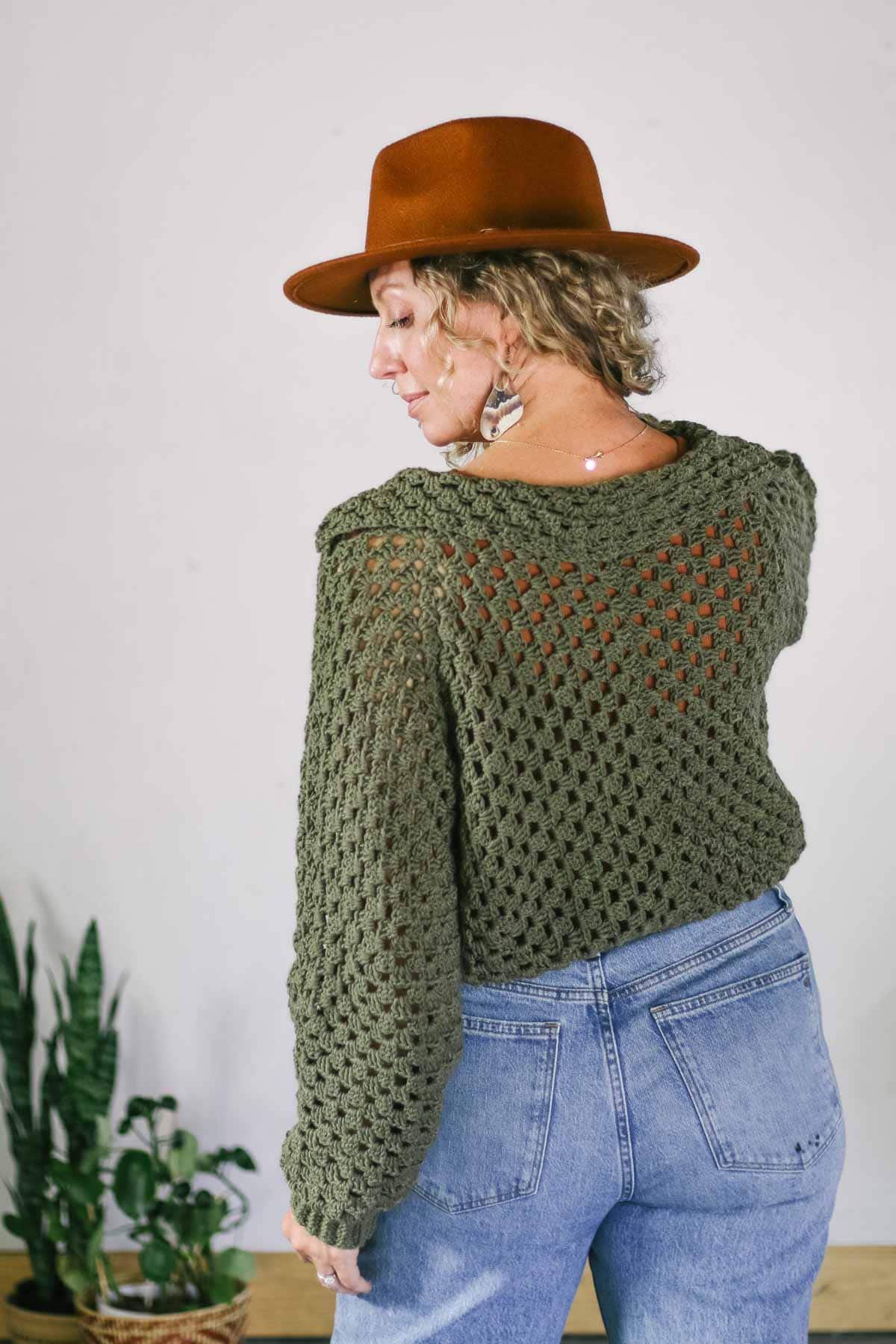
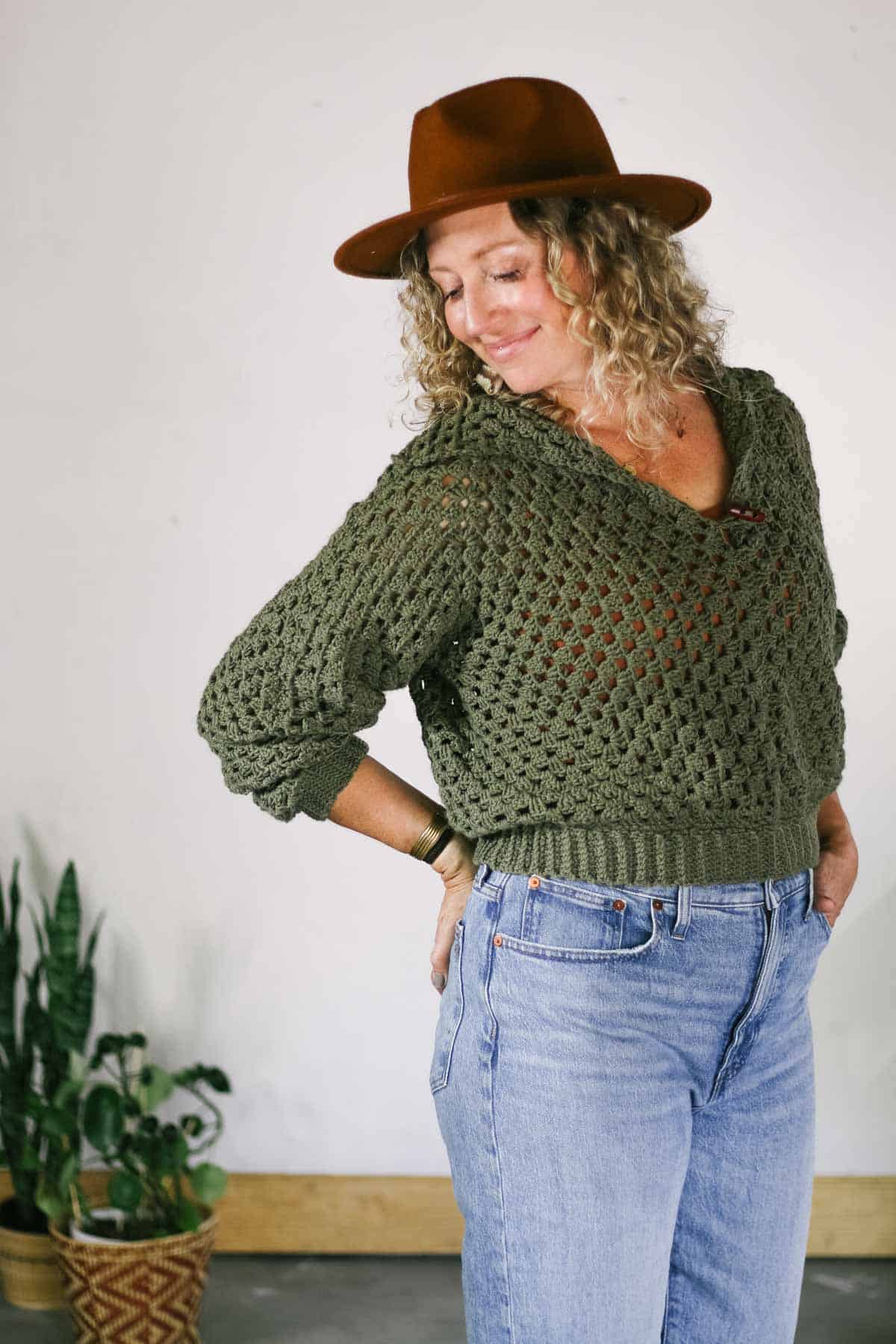
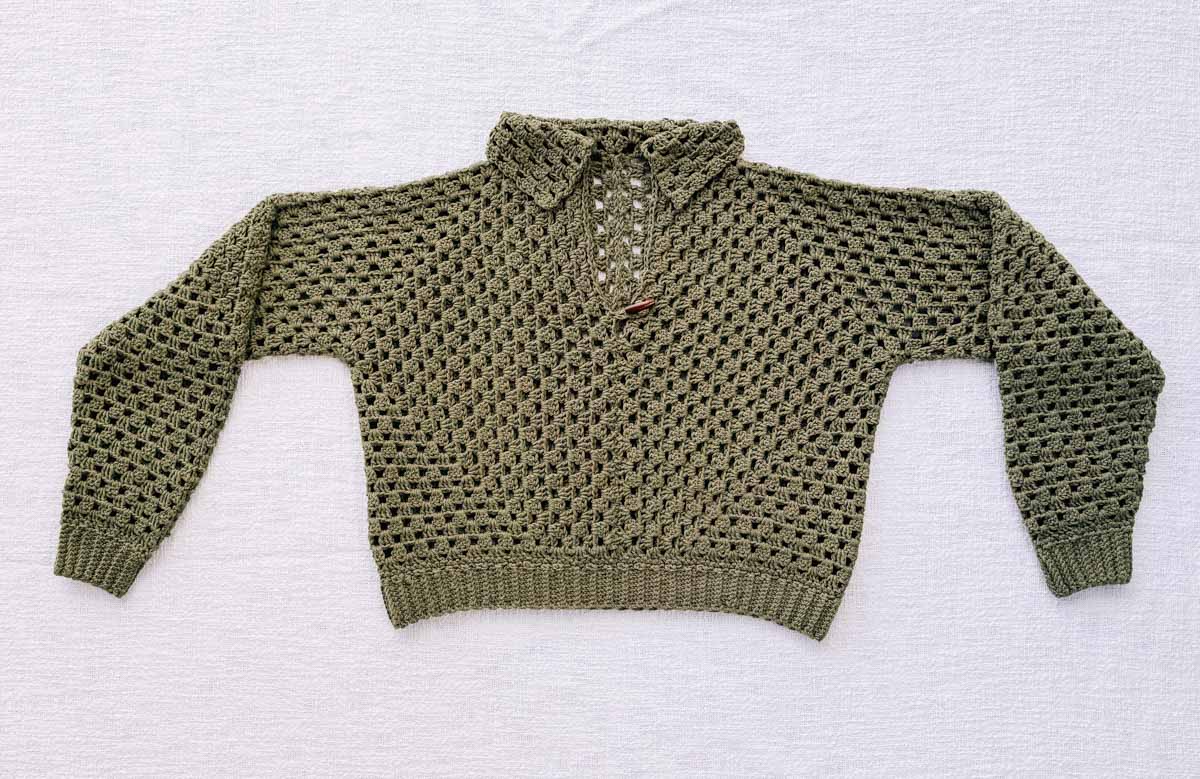
Crochet this easy, cropped hexagon sweater pattern using relaxing granny stitches. Thanks to simple crochet geometry, the hexagons shape into the sleeves and a modern pullover body.
And my fit-as-you-go tips make it easy to try on while you crochet, customize the length, and finish with a sweater that feels perfectly made for you.
The free Moss Sweater pattern (XS-5X) is below or purchase the ad-free, printable PDF.
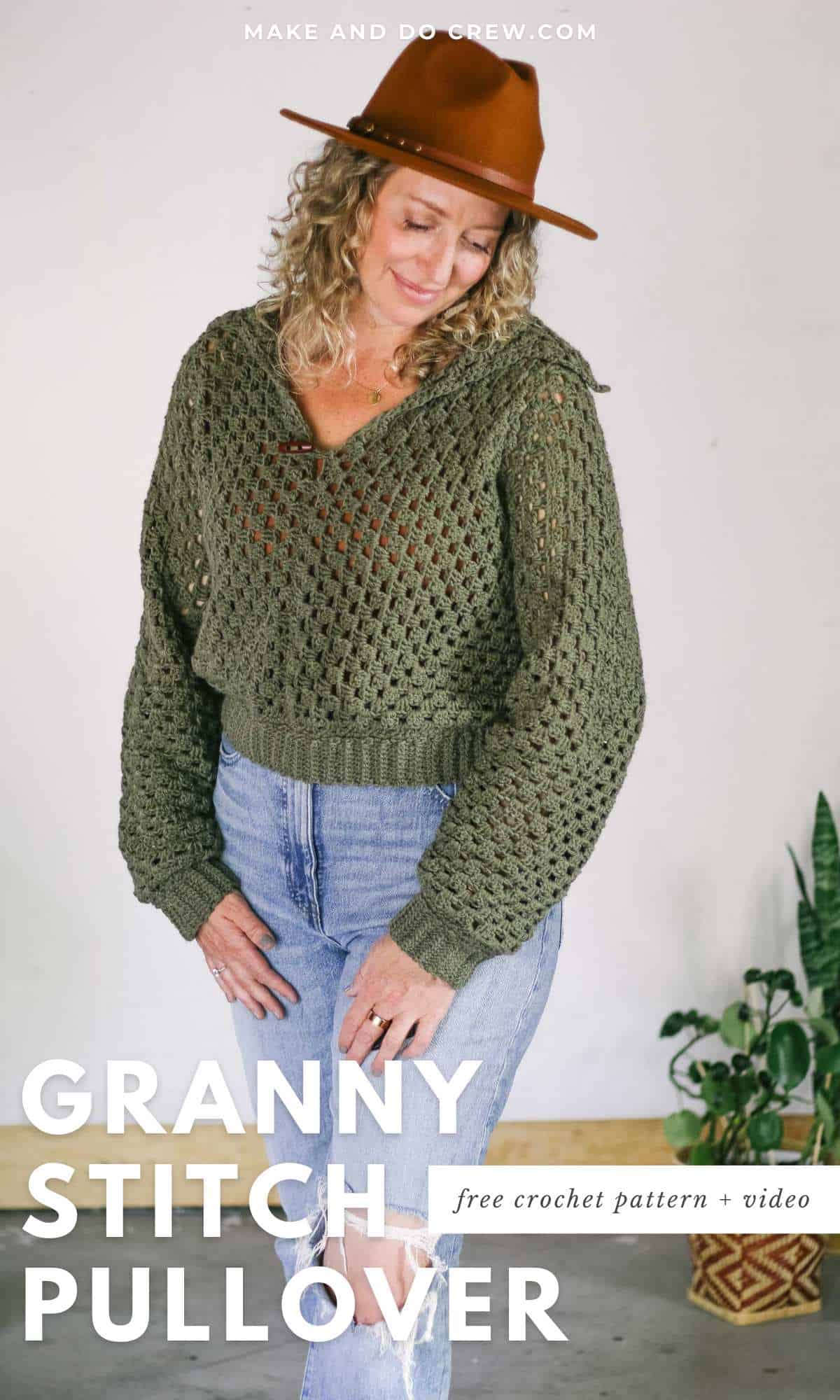
This hexi sweater crochet pattern is part of a collaboration with Lion Brand Yarns. This post contains affiliate links.
Jump to:
- The Moss Sweater - Free Crochet Pattern
- All-in-One Crochet Kit
- Print this Pattern
- Supplies + Materials
- Measurements
- Gauge
- Abbreviations + Glossary (US Terms)
- Step-By-Step Video Tutorial:
- Overall Pattern Notes
- How to Think About Your Hexagons
- Crocheting the Hexagons
- Trying On and Checking the Fit
- Sweater Sleeves
- Invitation to our Private Community
The Moss Sweater - Free Crochet Pattern
When we introduced the Campfire Cardigan, we helped popularize the idea that a couple of simple hexagons could transform into a cozy crochet sweater.
That pattern proved you don’t need complex shaping to make garments that fit, and since then thousands of makers have used the method to create cardigans in every style.
Now, we’ve reimagined the method as a pullover: the Moss Sweater.
All-in-One Crochet Kit
If you love to get fun packages in the mail, the all-in-one kit is a perfect way to make your Moss Sweater. This bundle from Lion Brand includes all the Color Theory yarn you'll need, plus a bonus printable PDF of the pattern (delivered digitally).
Print this Pattern
Prefer to crochet on the couch? Need a portable, printable pattern? You'll love the premium PDF! The instantly downloadable, ad-free file is formatted for easy printing and includes the complete pattern, all the photo tutorials, printable hexagon labels and a stitch chart.
Premium PDF
easier and faster with fewer mistakes.
- Complete pattern + photo tutorials
- Instant download
- Formatted for easy printing
Supplies + Materials
Order an all-in-one kit from Lion Brand.
• Lion Brand Color Theory (Weight 4/medium, 246 yds, 3.5 oz, 100g) - 550 (570, 610, 630, 650, 730, 810, 840)g total
Color: Caper [619-173AE] - 6 (6, 7, 7, 7, 8, 9, 9) skeins
• Main Body: Size K (6.5 mm) crochet hook or size needed to obtain gauge
• Ribbing: Size J (6.0 mm) crochet hook or one size smaller than larger, main body hook used to achieve gauge
• Stitch markers
• Tapestry needle
• Button for neckline (1.5” toggle button pictured)
• Blocking Board (optional)
• Steamer or iron with steam functionality
• T-pins for blocking
Measurements
When you meet the gauge listed below, here are the measurements you can expect your sweater to have.
| Size | Fits Actual Bust** | Sweater Length* | Chest Width* |
|---|---|---|---|
| XS/S | 31” | 17” | 19” |
| S/M | 35” | 17” | 21” |
| M/L | 39” | 19” | 23” |
| L/1X | 43” | 21” | 25” |
| 1X/2X | 47” | 21” | 27” |
| 2X/3X | 51” | 23” | 29” |
| 3X/4X | 55” | 25” | 31” |
| 4X/5X | 59” | 25” | 33” |
*Approximate measurements when laying flat
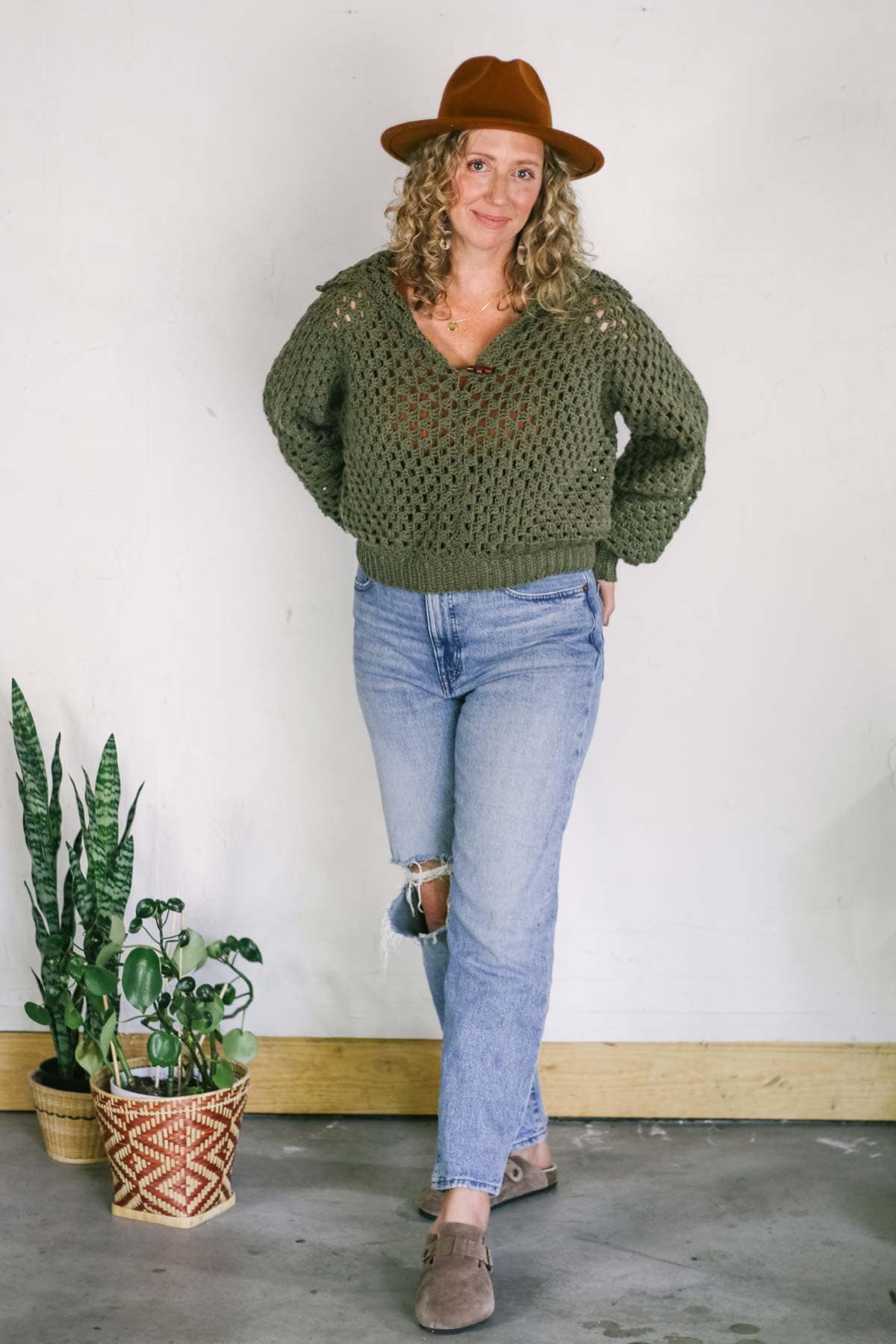
Finished sample pictured is a M/L on a model with a 39” bust.
** If between two sizes, size up or down based on how you’d like your sweater to fit. As written, it’s fairly loose. For a more fitted sweater, size down.
Gauge
4 granny clusters + 4 spaces = 4”
8 rounds/rows = just over 4” worked in double crochet granny pattern
Abbreviations + Glossary (US Terms)
blo – back loop only
ch – chain
cluster – 3 double crochet in same space
dc – double crochet
rep – repeat
RS – right side
sc – single crochet
slst – slip stitch
tch – turning chain
WS – wrong side
yo – yarn over
Skill Level
Difficulty level: ⅖ - Confident Advanced Beginner. You'll practice working in the round, increasing in granny stitch, seaming and evaluating the fit of your sweater as you go.
Step-By-Step Video Tutorial:
The Ember Hoodie video below demonstrates the main concepts you'll use to make your Moss Sweater.
Permissions + Copyright:
Please do not publish or share this pattern as your own. You may make items to sell with this pattern. In exchange, please link back this post. Do NOT use our photos as your own sales photos.
Overall Pattern Notes
- If you’re new to reading crochet patterns, check out more info here.
- Instructions are written with the stitch count for the smallest size first and each larger size following in parentheses, for example: XS/S (S/M, M/L, L/1X, 1X/2X, 2X/3X, 3X/4X and 4X/5X). It can be very helpful to highlight the numbers for your size before beginning the project. When only one number is given, it pertains to all sizes.
- Stitch counts at the end of each round are for given sizes.
- Chain 3 at beginning of round/row counts as 1 double crochet throughout pattern.
- Pattern is crocheted with larger hook unless otherwise mentioned.
- Weave in your ends at the end of each main section. You’ll thank yourself!
How to Think About Your Hexagons
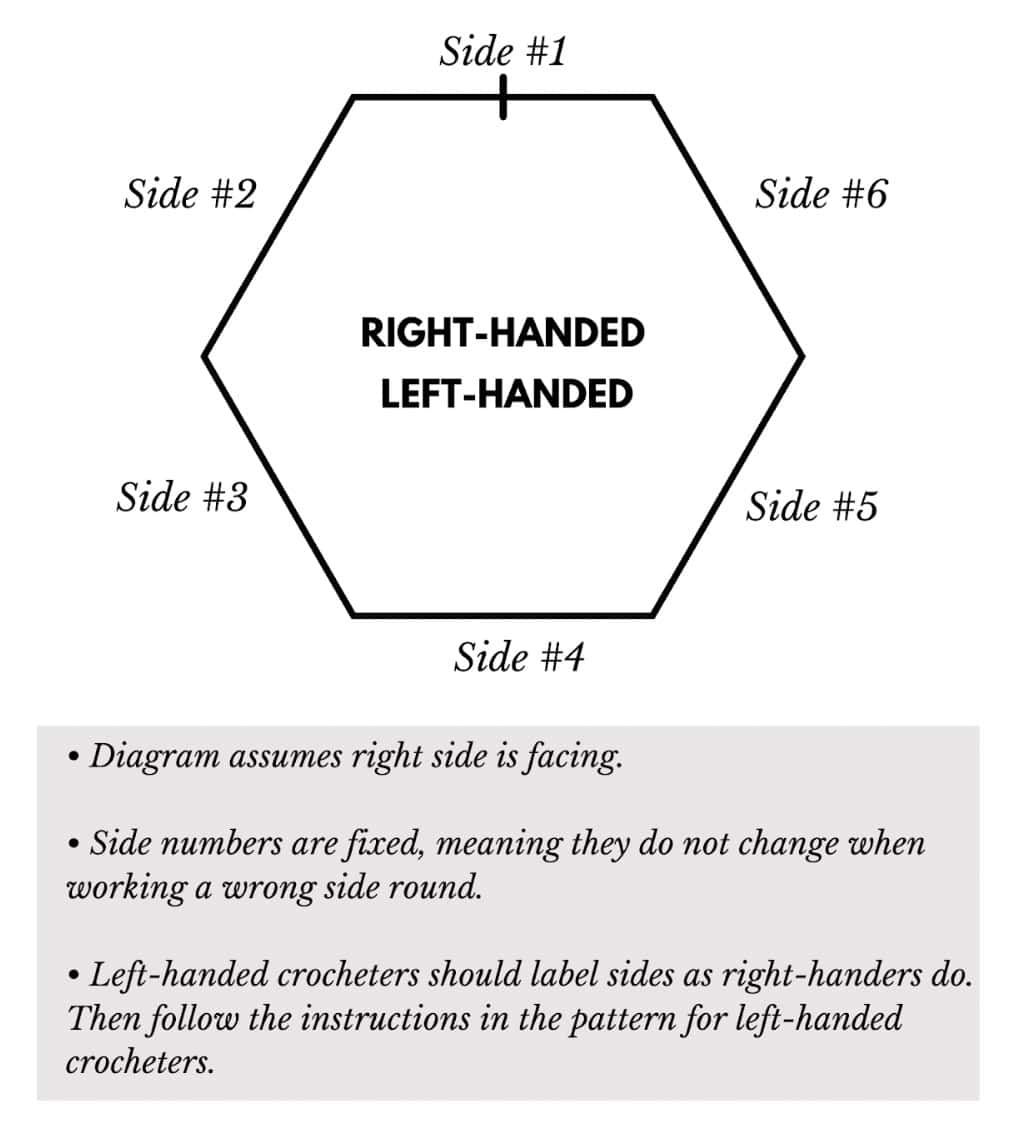
The pattern refers to the different sides of the hexagon by number, which is illustrated in the chart at the end of the pattern.
Think of these side numbers as fixed to the hexagon, regardless of orientation. For example, Side 3 is always Side 3, whether you flip the hexagon over or not. Side 3 does not become Side 5, just because the hexagon is flipped to the wrong side.
When you measure gauge after Round 8, please pin name tags as shown in the photos to each hexagon side. This will ensure you can easily identify hexagon locations as described in the pattern.
Crocheting the Hexagons
- Hexagon is worked in turned rounds.
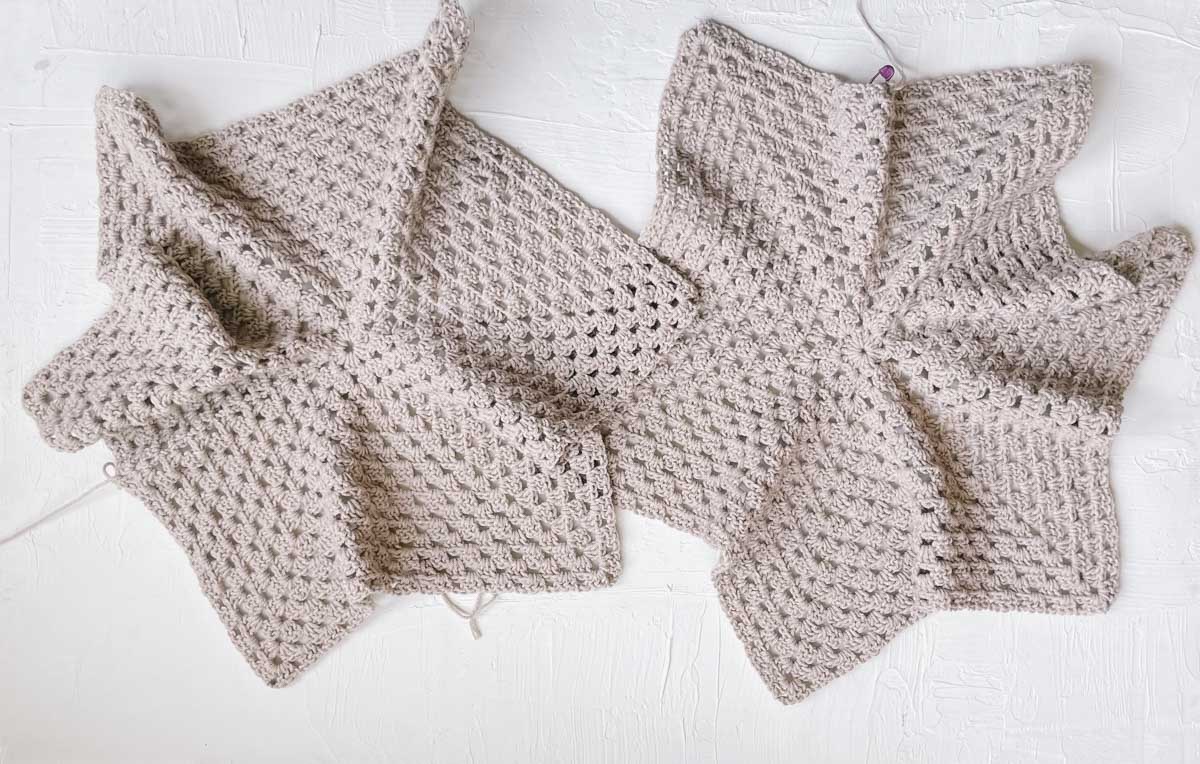
- After a few rounds, hexagon will look wavy and should not be able to lay flat. This is intentional to create enough fabric for the body and sleeves.
- Corner spaces will always be made of 3 chains. Spaces along the sides of the hexagon will be made with 1 chain. Reference stitch charts at end of pattern for extra visual clarification.
- If switching colors for a new round, use the new color to complete the final yarn over of the round you’re finishing. Fasten off previous color. Turn your work and proceed with new color in the next round.
Print This Pattern: purchase the ad-free, printable PDF with hexagon labels
Make 2.
Preferred Foundation: Create a magic ring.
Alternate Foundation: Ch 4 and slst to first ch to form a ring.

Don't spend hours for a "meh" result!
Tired of crocheting garments that don't fit? Learn our C.R.A.F.T. Framework to make sweaters that fit and feel amazing!
Round 1 (RS): Ch 3, 2 dc in ring, ch 1, ([3 dc in ring, ch 1]) 5 times, slst to top of ch 3 to join; turn. (6 sides, 1 cluster/side)
Round 2 (WS):
First corner: Ch 3, (2 dc, ch 3, 3 dc) all in first ch1sp…
Each corner: Ch 1, [(3 dc, ch 3, 3 dc, ch 1) all in corner ch1sp]…
To finish: Slst to top of ch 3 to join; turn. (2 clusters/side)
Want some company while you crochet?
Get support (and camaraderie!) in the Make & Do Crew community. Join for free here.
Round 3 (RS):
First Side: Ch 3, 2 dc in next ch1sp, ch 1…
Each corner: [(3 dc, ch 3, 3 dc) all in corner ch3sp, ch 1…
Each side: 3 dc in next ch1sp, ch 1…
Repeat side and corner stitches around hexagon.
To finish: (3 dc, ch 3, 3dc) all in last corner ch3sp, ch 1, slst to top of ch 3 to join; turn. (3 clusters/side)
Round 4 (WS):
To Begin: Ch 3, 2 dc in next ch1sp, ch 1…
Each corner: (3 dc, ch 3, 3 dc) all in corner ch3sp, ch 1…
Each side: (3 dc, ch 1) in each ch1sp to corner…
Repeat side and corner stitches around hexagon.
To finish: Slst to top of ch 3 to join; turn. (4 clusters/side)
Round 5 (RS): Rep Round 4. (5 clusters/side)
Round 6 (WS): Rep Round 4. (6 clusters/side)
Round 7 (RS): Rep Round 4. (7 clusters/side)
Round 8 (WS): Rep Round 4. (8 clusters/side)
!! Gauge Check !!
Please stop and take a minute to measure your hexagon. This will ensure your sweater is the size you expect it to be. Measure from the center of the hexagon to the center of the edge on one side (radius). This should measure approximately 4” or just over.
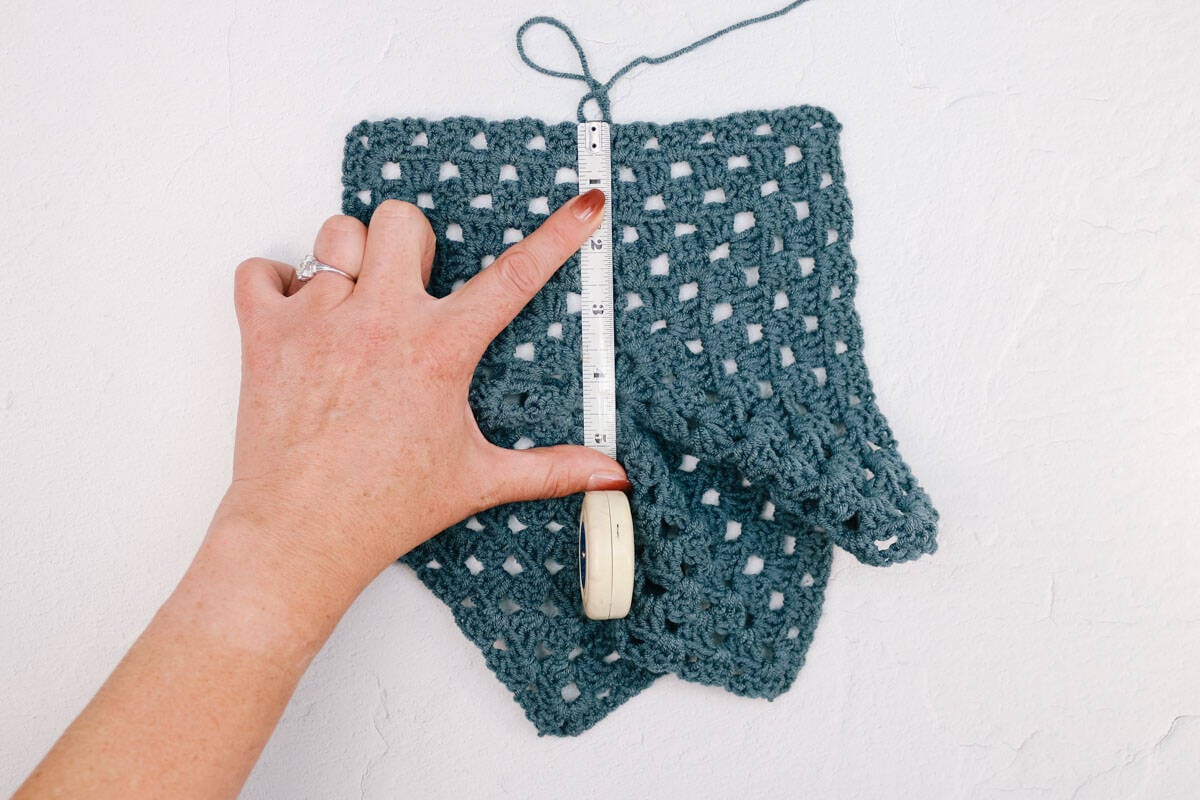
Measure several sides of the hexagon. Each side should measure 7.5-8”. If your hexagon radius or each side length is too large, decrease your hook size and rework hexagon. If your hexagon radius is too small or each side length is too small, increase your hook size and rework hexagon.
Once correct gauge is established, lay hexagon flat with RS facing up. (Last round worked was a WS round.) Use stitch markers to pin side-number name tags to each side according to the chart at the end of the pattern.
Rounds 9-14 (14, 16, 16, 16, 18, 18, 20): Rep Round 4. Hexagon should now contain 14 (14, 16, 16, 16, 18, 18, 20) rounds. Final round should have 14 (14, 16, 16, 16, 18, 18, 20) clusters per side and measure approximately 7 (7, 8, 8, 8, 9, 9, 10)” from center of hexagon to middle of one of the edges.
| 🧶 Correcting Course: If your measurements are off considerably, you may eliminate or add repeats of Round 4 here to get the correct sizing. Be sure to end with a WS round. As with any pattern modification, it will affect future stitch counts and may impact the amount of yarn you need. |
Back + Front Extensions
Extra rows are now worked along specific sides on each hexagon to extend fabric that will form the center back and center front of the sweater.
If switching colors at the end of a row, use the color of the upcoming row to complete the final yarn over of the row you’re finishing. Fasten off previous color. Proceed with new color in the next row.
Tip: At the end of each Extension, consider keeping yarn attached by putting a stitch marker through the live loop. While this makes for more yarn balls to juggle, it will make it easier to adjust the fit in the next step, if desired.
Left Side of Sweater as Worn
- Back = side #5, Bottom = side #4, Front = side #3
- Chain 4 counts as 1 double crochet + 1 chain space.
Back Extension
You will work along Side #5 only.
Right-handed crocheters: Attach yarn in ch3sp corner between Sides #4 and #5.
Left-handed crocheters: Attach yarn in ch3sp corner between Sides #5 and #6.
Row 1 (RS): Ch 3, 2 dc in same ch3sp, *ch 1, 3 dc in next ch1sp; rep from * along side until only corner remains, ch 1, 3 dc in corner ch3s; turn. (15 (15, 17, 17, 17, 19, 19, 21) clusters)
Row 2 (WS): Ch 4, *3 dc in next ch1sp, ch 1; rep from * along side until 1 cluster remains, dc in top of tch; turn. (14 (14, 16, 16, 16, 18, 18, 20 clusters + 2 dc)
Row 3 (RS): Ch 3, 2 dc in first ch1sp, *ch 1, 3 dc in next ch1sp; rep from * along side until 1 cluster remains, ch 1, 3 dc in last ch1sp; turn. (15 (15, 17, 17, 17, 19, 19, 21) clusters)
Rep Rows 2 and 3 one (two, two, three, four, four, five, five) more times. Back extension should now contain 5 (7, 7, 9, 11, 11, 13, 13) rows.
Keep yarn attached here by putting a stitch marker through the live loop, or fasten off leaving a long tail for seaming.
Front Extension
You will work along Side #3 only.
Right-handed crocheters: Attach yarn in ch3sp corner between Sides #2 and #3.
Left handed crocheters: Attach yarn in ch3sp corner between Sides #3 and #4.
Repeat the instructions for Back Extension.
Right Side of Sweater as Worn
- Back = Side #3, Bottom = Side #4, Front = Side #5
- Chain 4 counts as 1 double crochet + 1 chain space.
Back Extension
You will work along Side #3 only.
Right-handed crocheters: Attach yarn in ch3sp corner between Sides #2 and #3.
Left-handed crocheters: Attach yarn in ch3sp corner between Sides #3 and #4.
Row 1 (RS): Ch 3, 2 dc in same ch3sp, *ch 1, 3 dc in next ch1sp; rep from * along side until only corner remains, ch 1, 3 dc in corner ch3s; turn. (15 (15, 17, 17, 17, 19, 19, 21) clusters)
Row 2 (WS): Ch 4, *3 dc in next ch1sp, ch 1; rep from * along side until 1 cluster remains, dc in top of tch; turn. (14 (14, 16, 16, 16, 18, 18, 20 clusters + 2 dc)
Row 3 (RS): Ch 3, 2 dc in first ch1sp, *ch 1, 3 dc in next ch1sp; rep from * along side until 1 cluster remains, ch 1, 3 dc in last ch1sp; turn. (15 (15, 17, 17, 17, 19, 19, 21) clusters)
Rep Rows 2 and 3 one (two, two, three, four, four, five, five) more times. Back extension should now contain 5 (7, 7, 9, 11, 11, 13, 13) rows.
Keep yarn attached here by putting a stitch marker through the live loop, or fasten off leaving a long tail for seaming.
Front Extension
You will work along Side #5 only.
Right-handed crocheters: Attach yarn in ch3sp corner between Sides #4 and #5.
Left handed crocheters: Attach yarn in ch3sp corner between Sides #5 and #6.
Repeat instructions for Back Extension.
Premium PDF
easier and faster with fewer mistakes.
- Complete pattern + photo tutorials
- Instant download
- Formatted for easy printing
Trying On and Checking the Fit
The simple seaming process that follows is a great opportunity to try your hexagons on and check the fit of your sweater so far. To do this, follow all the folding and pinning instructions below, but do not actually sew the pieces together before trying them on.
If you’re happy with the fit, carry on with seaming. If you’d like to adjust the fit slightly, here’s how to do it:
| 🧶To make your sweater bust fit tighter: Remove rows from the Back Extensions (and the same number from the Front extensions). For example, you might remove 2 rows from the Back and Front Extensions on both hexagons. This would reduce the overall circumference of the sweater bust by about 4”. 🧶 To make your sweater bust fit looser: Add rows to the Back Extensions (and the same number to the Front extensions). For example, you might add 2 rows to the Back and Front Extensions on both hexagons. This would increase the overall circumference of the sweater bust by about 4”. NOTE: As with anytime you adjust a given pattern, making changes here will affect the stitch counts in other sections of your garment. (Namely, your Bottom Extension.) This shouldn’t create too much confusion, but I want you to have a heads up ahead of time. Also, making sizing adjustments like this may affect the amount of yarn needed to complete your project. |
Joining Hexagons
To Fold and Create the Sleeves:
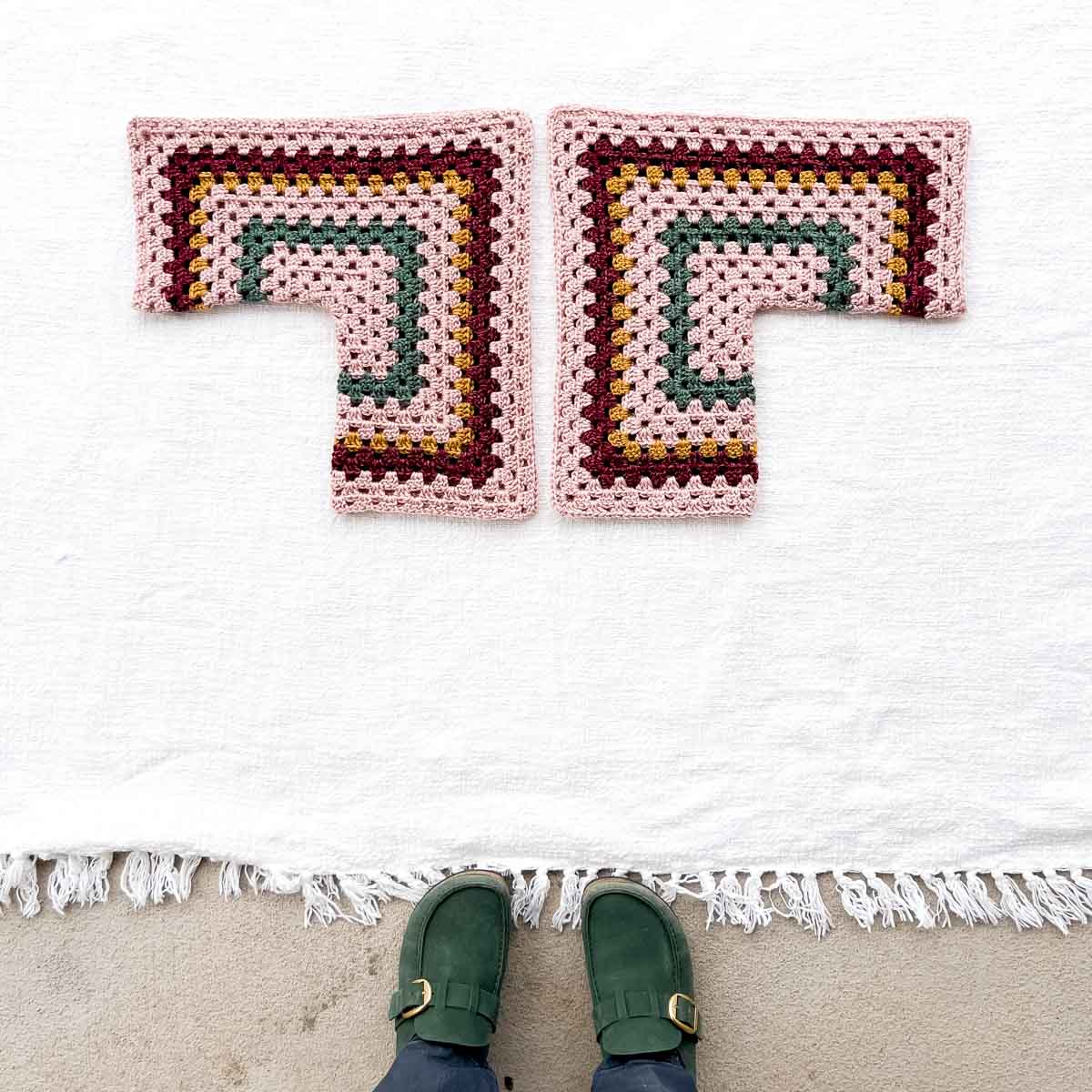
The following instructions are to be completed on one hexagon at a time. With RS facing together, use stitch markers to pin Sides #2 and #6 together. Take care to line up clusters on either side of hexagon sides. Pin in place using stitch markers. Folded hexagon should now resemble an “L” shape, with front and back extensions sitting atop each other.
Using a tapestry needle and the same color yarn used in your last hexagon round, sew sleeve seam from the hexagon edge (elbow area) toward shoulder using the mattress stitch. Stop sewing when 5 (7, 7, 7, 7, 7, 7, 7) rows of the extensions are left unseamed.
Repeat with second hexagon.
To Join the Back Extensions:
With RS still facing in, lay hexagons next to each other so Back extensions are touching. Pin in place, taking care to line up clusters on either side of extensions.
Using a tapestry needle and existing yarn tail, sew extensions together using the mattress stitch.
To Join the Front Extensions:
With RS still facing in, pin Front extensions together, taking care to line up clusters on either side of extensions. In the sample pictured, eight clusters are left unseamed for the V-neck, but this can be customized to be more or less open. (This is a good time to try on your sweater and make sure you’re happy before further seaming!)
Using a tapestry needle and existing yarn tail, sew front seam from the bottom edge upward using the mattress stitch.
Flip sweater RS out.
Congrats! You’ve got yourself an adorable lil’ mini sweater!
Bottom Extension
- When working Round 1, you will crochet along bottom hexagon Sides #4 as well as along the row edges of the Back and Front extensions. When crocheting into the edges of the Extensions, you will work into each row edge that begins with a chain 4. You will skip the row ends that begin with a cluster. This will make more sense as you’re crocheting the row.
Wanna save this pattern?
With RS of sweater facing, attach yarn in a ch1sp beneath either underarm.
Round 1 (RS):
Getting Started (all sizes): Ch 3, 2 dc in same chain space…
Along first hexagon side: *ch 1, 3 dc in next ch1sp; rep from * along bottom of hexagon, 3 dc in hexagon corner ch3sp…
Along Front/Back extensions: *sk next extension row edge, ch 1, 3 dc in next extension row edge; rep from * along bottom of extensions (work 3 dc in the seam that joins the extensions), sk last extension row edge…
Along second hexagon side: ch 1, 3 dc in corner ch3sp, *ch 1, 3 dc in next ch1sp; rep from * along bottom of hexagon, 3 dc in hexagon corner ch3sp…
To continue: Work in established pattern over next set of extensions and to finish last section of first hexagon.
To finish round: End round with a ch 1, slst to top of ch 3 to join; turn.
Sizes XS/S, S/M, M/L only: Stop here. Bottom Extension should contain 1 round. Do not fasten off.
All other sizes: Continue.
Round 2 (WS): Ch 3, 2 dc in first ch1sp, ch 1, *3 dc in next ch1sp, ch 1; rep from * (3 dc, ch 1) in each ch1sp to end of round, slst to top of ch 3 to join; turn. (42 (46, 50, 54, 58, 62, 66, 70) clusters)
Round 3 (RS): Rep Round 2.
Sizes L/1X, 1X/2X, and 4X/5X only: Stop here. Bottom Extension should contain 3 rounds. Do not fasten off.
Sizes 2X/3X and 3X/4X only: Rep Rounds 2-3 once more. Bottom Extension should contain 5 rounds. Do not fasten off.
You can try on your sweater here and evaluate the length. If you’re happy, proceed to Ribbing. (If a different color ribbing is desired, fasten off and attach ribbing yarn in same place as last extension stitch.)
| 🧶 For a more cropped sweater: Eliminate rounds in the above section, making sure to end with a RS round (Round 1, 3, etc). 🧶 For a longer sweater: Work additional rounds in the above section, making sure to end with a RS round (Round 1, 3, etc). |
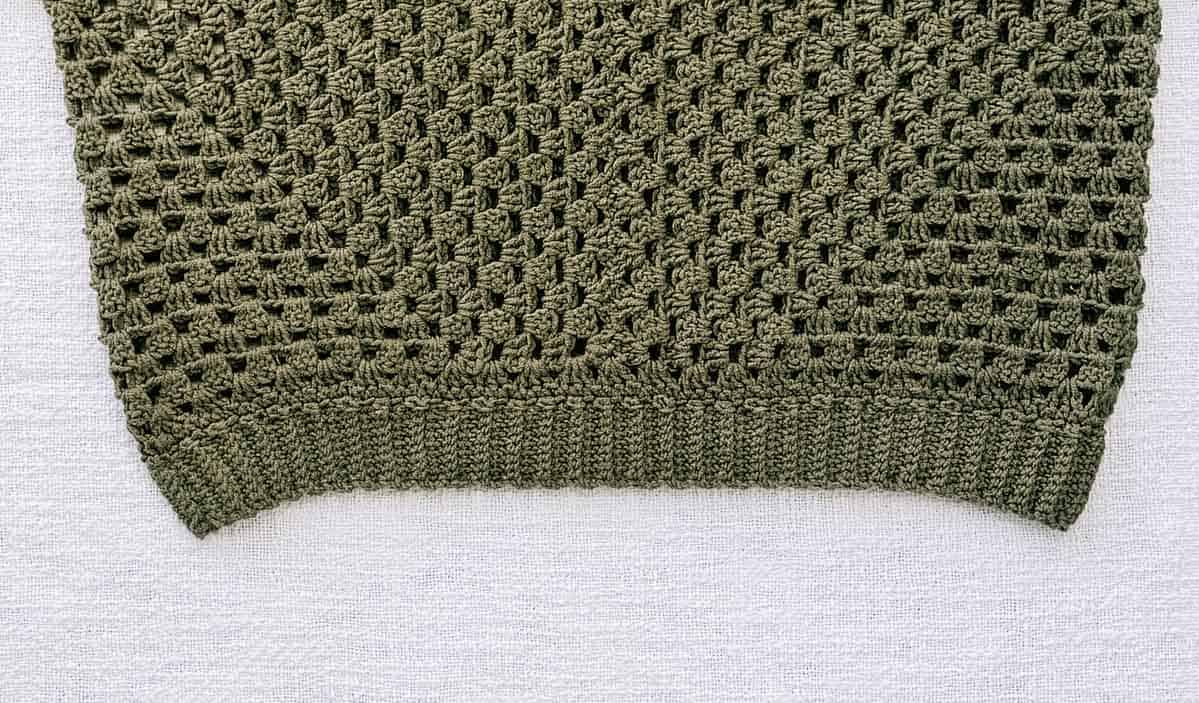
Bottom Ribbing
- Ribbing is worked in rows perpendicular to bottom sweater edge. Ribbing is attached as it’s created by slip stitching to sweater bottom.
- Each single crochet is worked through the back loop only (blo) of the stitch in the previous row. On even rows only (those heading away from sweater), the last stitch of the row is worked through both loops.
- Pay attention to the RS/WS designation of row as it will help clarify which side of sweater is facing in each row.
- If shorter ribbing is desired, consider modifying Foundation Chain length to 6 ch. (This will create a bottom ribbing of 5 sts tall.)
With smaller hook:
Ribbing Set Up Round (RS): Using same color yarn you’ll use for ribbing, ch 1, sc in each dc of last extension round, around entire bottom of sweater. Do not sc in ch1sps. Keep yarn attached.
Foundation: With attached yarn, ch 10.
Row 1 (WS): Sc in second ch from hook, sc in each st, slst to second sc of Ribbing Set Up Row (sweater), slst to next sc; turn. (9 sc + 2 slsts on sweater)
TIP: Count your single crochets here to ensure there are 9. Recount periodically as you work ribbing because sometimes these stitches can be easy to accidentally drop along the way.
Row 2 (RS): (Do not ch 1), sk slsts along sweater bottom, sc in the blo of each sc until 1 remains, sc through both loops of the last st; turn. (9 sc)
Row 3 (WS): Ch 1, sc though blo of each sc, slst to next unworked sweater sc, slst to next sweater sc; turn.
Row 4 (RS): Rep Row 2.
Rep Rows 3 and 4 around sweater bottom, ending with a Row 4. This may require slip stitching only one stitch instead of two along Ribbing Set Up Round on the final repeat. It’s fine to improvise here to ensure you end with a Row 4. This will position the yarn at the bottom of the sweater. Do not fasten off.
Joining Ribbing:
Turn sweater WS out. Line up first and last rows of ribbing, with last row facing you. Slip stitch through each stitch to join ribbing, working through front loop of last row and one loop of foundation chain for each stitch. Fasten off at end of seam.
Sweater Sleeves
Two sleeve options are included:
🧶Tapered: Follow the tapered option to create a sleeve shape that narrows toward the wrist. This is the version pictured in the sample photos.
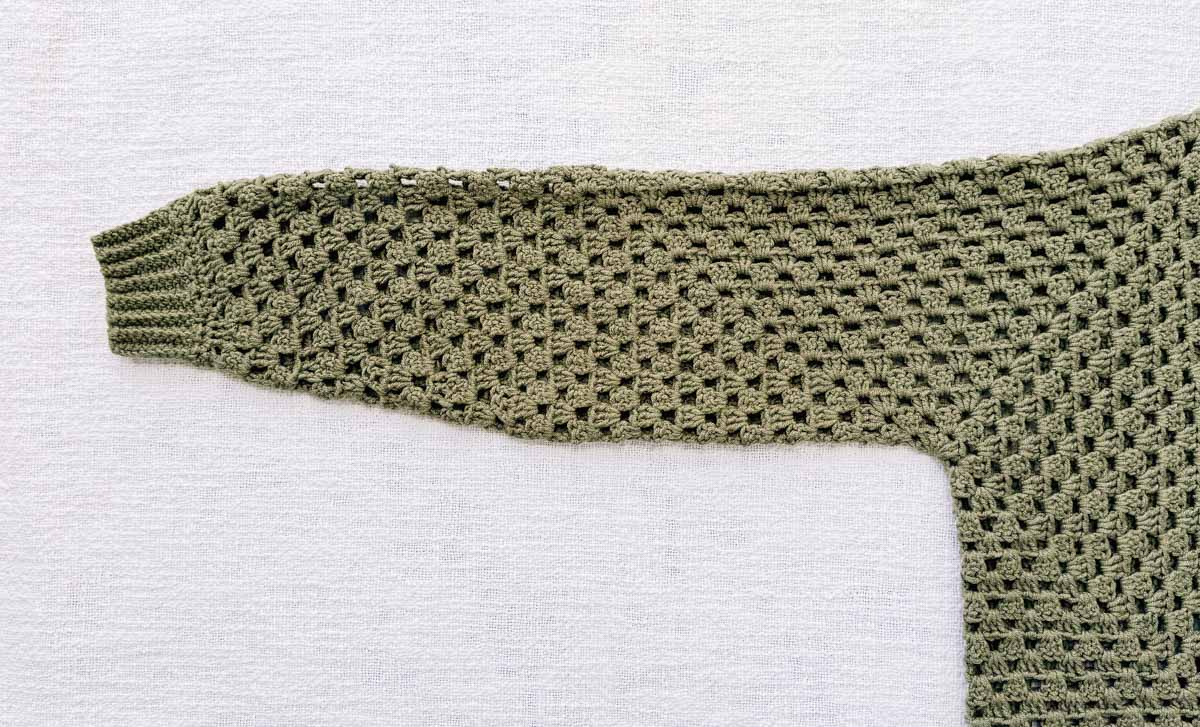
🧶 Open: Alternatively, the non-tapered sleeve option does not include decreases, making it ideal for beginners. The wrist opening will be as wide as the current arm opening on your sweater, creating a more open, bell-style sleeve.
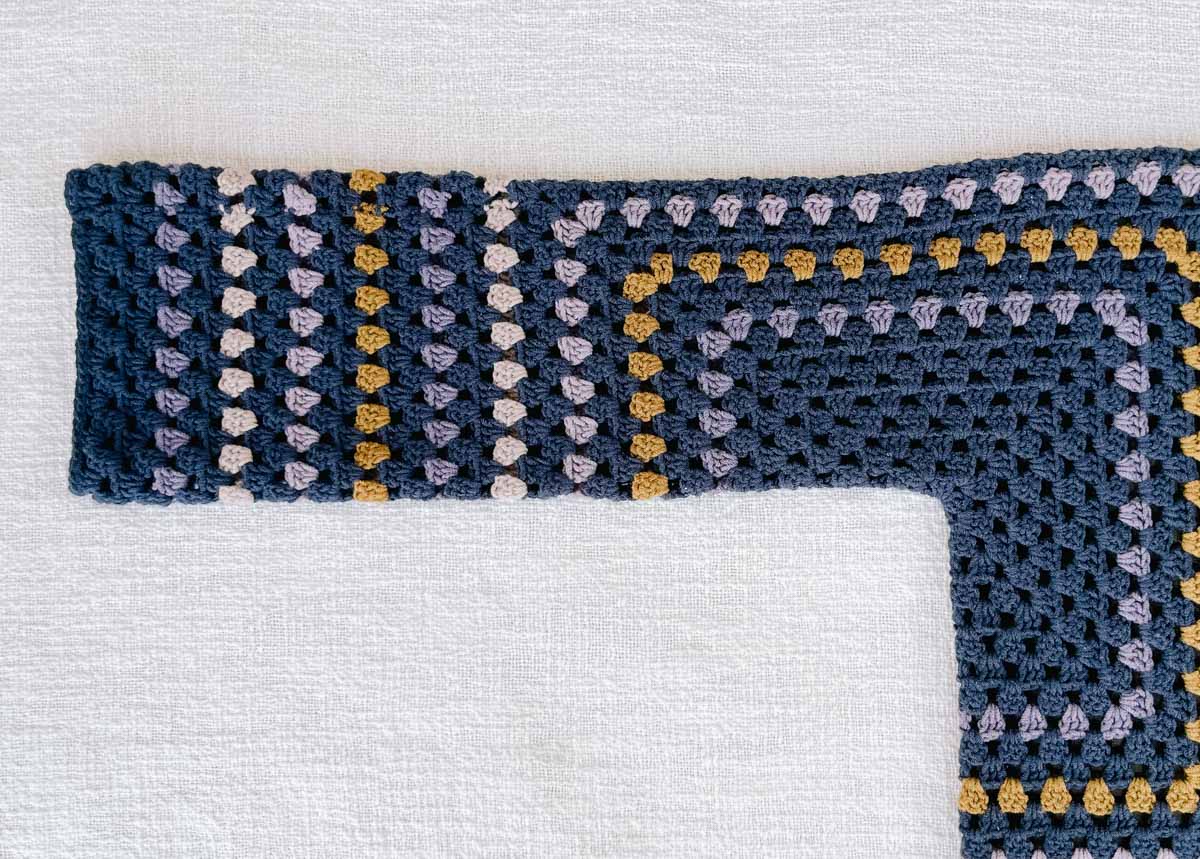
All Styles of Sleeves:
With RS facing out, lay sweater so shoulder hexagon seam is visible. There will be two hexagon corner spaces at the end of the shoulder seam near the elbow. One corner space is technically on the front of the sweater and the other is technically on the back of the sweater. You’ll attach your yarn in one of these spaces depending on your dominant hand.
Right and left-handed crocheters: Attach yarn in hexagon corner space on the same side as your dominant hand.
Round 1 is worked with right side of sweater facing out. This means right-handed crocheters will work clockwise. Left-handed crocheters will work counter clockwise.
Again, this section is easily customizable to fit your arms. Work fewer rounds for shorter sleeves or extra rounds for longer sleeves.
Tapered Sleeve Option
- Decreases are alternated between the top and bottom of the sleeve to minimize any bunching. The exact placement of the decreases doesn’t matter though, so just aim for the correct general area.
Round 1 (RS): Ch 3, dc in middle of shoulder seam, dc in next hexagon corner sp (1 cluster made), ch 1, *3 dc in next ch1sp, ch 1; rep from * until end of round, slst to top of ch 3 to join; turn. (14 (14, 16, 16, 16, 18, 18, 20) clusters)
Round 2 (WS): Ch 3, 2 dc in same ch1sp (1 cluster made), ch 1, *3 dc in next ch1sp, ch 1; rep from * until end of round, slst to top of ch 3 to join; turn. (14 (14, 16, 16, 16, 18, 18, 20) clusters)
Round 3 (RS): Ch 3, 2 dc in same ch1sp (1 cluster made), ch 1, *3 dc in next ch1sp, ch 1; rep from * until end of round, slst to top of ch 3 to join; turn. (14 (14, 16, 16, 16, 18, 18, 20) clusters)
Round 4 (WS dec): Ch 3, 2 dc in same ch1sp (1 cluster made), ch 1, *3 dc in next ch1sp, ch 1**; rep from * to ** until underside of sleeve, dc in next ch1sp, dc in center of nextcluster, dc in next ch1sp, (1 decrease made) rep from * to ** to end of round, slst to top of ch 3 to join; turn. (13 (13, 15, 15, 15, 17, 17, 19) clusters)
Round 5 (RS): Rep Round 3.
Round 6 (WS): Rep Round 2.
Round 7 (RS dec): Ch 3, 2 dc in same ch1sp (1 cluster made), dc in next ch1sp, dc in center of next cluster, dc in next ch1sp, (1 decrease made), ch 1, *3 dc in next ch1sp, ch 1**; rep from * to end of round, slst to top of ch 3 to join; turn. (12 (12, 14, 14, 14, 16, 16, 18) clusters)
Sizes M/L, L/1X and 1X/2X only: Rep Rounds 2-7 once more. (- (-, 12, 12, 12, -, -, -) clusters)
Sizes 2X/3X, 3X/4X and 4X/5X only: Rep Rounds 2-5 three more times. (- (-, -, -, -, 13, 13, 15) clusters
Sizes XS/S, S/M, M/L, L/1X, 1X/2X only: Rep Rounds 2-4 once more. (11 (11, 11, 11, 11, -, -, -) clusters)
Sleeve section should now contain 10 (10, 16, 16, 16, 19, 19, 19) rounds.
Work additional repeats of Rounds 3 and 2 to lengthen sleeves if desired.
Keep yarn attached for ribbing.
Cuff Ribbing
- Ribbing is created using same technique as bottom ribbing. Return to that section and review notes if necessary.
- If shorter ribbing cuff is desired, consider modifying Foundation Chain length to 5 ch. (This will create a cuff ribbing 4 sts long.)
With smaller hook and attached yarn:
Ribbing Set Up Round (RS): Ch 1, sc in each dc of last sleeve row (do not sc in ch1sps), slst to first sc of round to join. Keep yarn attached.
Right-handed crocheters: Ribbing is worked in perpendicular rows clockwise around sleeve.
Left-handed crocheters: Ribbing is worked in perpendicular rows counter-clockwise around sleeve.
Foundation: With attached yarn, ch 11.
Row 1 (RS): Sc in second ch from hook, sc in each st, slst to second sc of Ribbing Set Up Row, slst to next sc; turn. (10 sc + 2 slsts on sweater)
Row 2 (WS): (Do not ch 1), sk slsts along sleeve edge, sc in the blo of each sc until 1 rem, sc through both loops of the last st; turn. (10 sc)
Row 3 (RS): Ch 1, sc though blo of each sc, slst to next unworked sleeve sc, slst to next sleeve sc; turn.
Row 4 (WS): Rep Row 2.
Rep Rows 3 and 4 around sleeve, ending with a Row 3. This may require slip stitching only one stitch instead of two along sleeve on the final repeat. It’s fine to improvise here to ensure you end with a Row 4. This will position the yarn at the end of the sleeve cuff. Keep yarn attached.
Joining Cuff
Turn sleeve WS out. Line up first and last rows of ribbing, with last row facing you. Slip stitch through each stitch to close cuff, working through the outer loop of last row and one loop of foundation chain for each stitch. Fasten off at end of seam.
Repeat instructions for second sleeve.
Non-Tapered Sleeve Option
- When working Round 1, top of sleeve seam where hexagons meet counts as 1 granny cluster. (This means you’ll work 3 dc into each ch1sp on either side of the seam, chaining 1 in between.)
Make 2.
Round 1 (RS): Ch 3, dc in middle of shoulder seam, dc in next hexagon corner sp (1 cluster made), ch 1, *3 dc in next ch1sp, ch 1; rep from * until end of round, slst to top of ch 3 to join; turn. (14 (14, 16, 16, 16, 18, 18, 20) clusters)
Round 2 (WS): Ch 3, 2 dc in same ch1sp (1 cluster made), ch 1, *3 dc in next ch1sp, ch 1; rep from * until end of round, slst to top of ch 3 to join; turn. (14 (14, 16, 16, 16, 18, 18, 20) clusters)
Round 3 (RS): Ch 3, 2 dc in same ch1sp (1 cluster made), ch 1, *3 dc in next ch1sp, ch 1; rep from * until end of round, slst to top of ch 3 to join; turn. (14 (14, 16, 16, 16, 18, 18, 20) clusters)
Rounds 4-13 (15, 19, 19, 19, 21, 21, 21): Rep Rounds 2-3. To shorten/lengthen sleeves, work fewer or more repeats here. Fasten off.
Collar
- Collar is worked into the edge of the neckline.
- As done previously if switching colors at the end of a row, use the color of the upcoming row to complete the final yarn over of the row you’re finishing. Fasten off previous color. Proceed with new color in the next row.
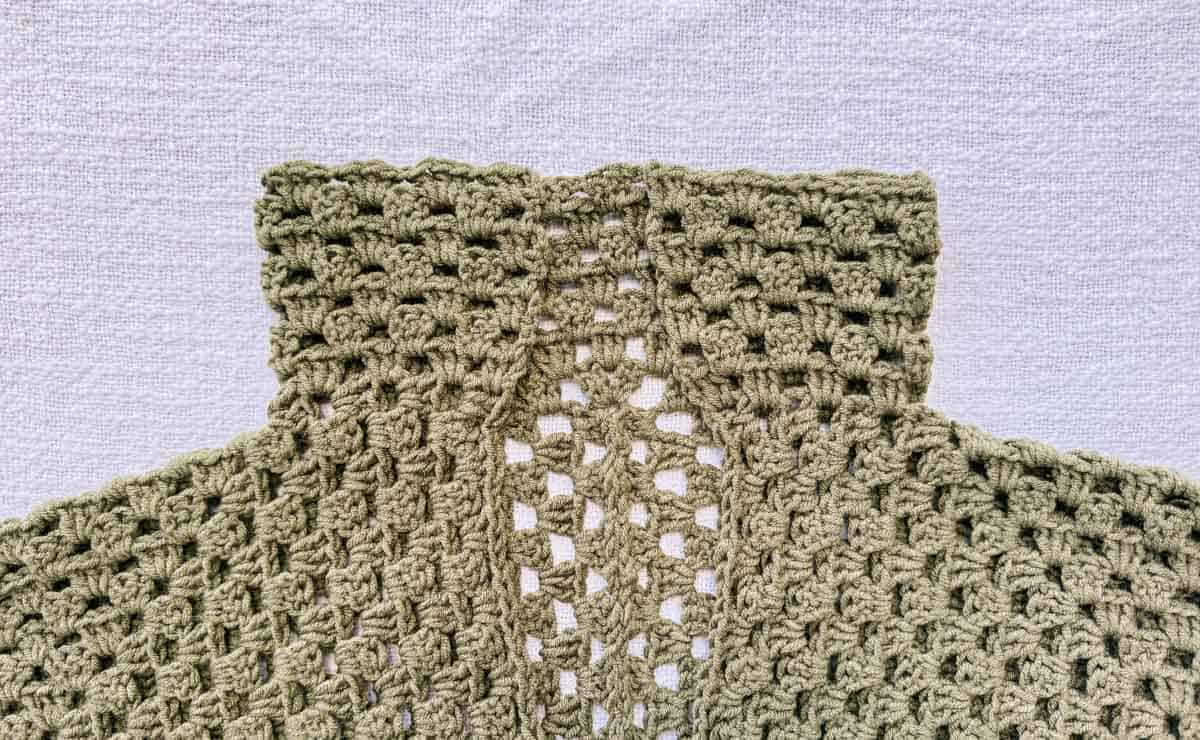
All sizes:
With RS facing:
Right-handed crocheters: Attach yarn in top of final cluster of Front Extension on the right side of sweater as worn. (This means you’ll join your yarn in the last double crochet of the Side #5 extension, near your collarbone.)
Left-handed crocheters: Attach yarn in top of final cluster of Front Extension on the left side of sweater as worn. (This means you’ll join your yarn in the last double crochet of the Side #3 extension, near your collarbone.)
Row 1 (RS):
First hexagon side: Ch 3, 2 dc in same space yarn attached in, ch 1, (3 dc, ch 1) in each chsp including hexagon corner ch3sp…
Along Back extensions: *sk next extension row edge, ch 1, 3 dc in next extension row edge; rep from * along top of extensions. Work (2 dc, ch 1, 2 dc) in seam joining back extensions), sk last extension row edge…
Along back of neck: 3 dc in next hexagon corner ch3sp, *sk next extension row edge, ch 1, 3 dc in next extension row edge; rep from * along first back extension…
Back seam: ch 1, (2 dc, ch 1, 2 dc) in seam joining back extensions, ch 1…
Along back of neck: *sk next extension row edge, ch 1, 3 dc in next extension row edge; rep from * along first back extension, sk last extension row edge, 3 dc in next hexagon corner ch3sp…
Second hexagon side: 3 dc in hexagon corner ch3sp, ch 1, (3 dc, ch 1) in each chsp, 3 dc in top of Front Extension cluster; turn. (19 (20, 20, 20, 20, 20, 20, 20) clusters)
Row 2 (WS): Ch 4, *3 dc in next ch1sp, ch 1; rep from * until 1 cluster remains, dc in top of tch; turn. (18 (19, 19, 19, 19, 19, 19, 19) clusters + 2 dc)
Row 3 (RS): Ch 3, 2 dc in first ch1sp, *ch 1, 3 dc in next ch1sp; rep from * until 1 cluster remains, ch 1, 3 dc in last ch1sp; turn. (19 (20, 20, 20, 20, 20, 20, 20) clusters)
XS/S only: Place marker in middle st of the 10th cluster.
All other sizes: Place marker in center ch1sp of last row (- (10th, 10th, 10th, 10th, 10th, 10th 10th) space as counted from either edge of collar.) In the increase instructions below, each set of 2 double crochets counts as one cluster.
Row 4 (WS inc): Ch 4, *3 dc in next ch1sp, ch 1**; rep from * until marker, (2 dc, ch 1, 2 dc) in marked st/ch1sp, rep from * until 1 cluster remains, dc in top of tch; turn. (20 clusters + 2 dc for all sizes)
Remove markers.
Rows 5 - 7: Rep Rows 2-3, ending with a RS row.
Sizes XS/S, S/M, M/L and L/1X: Stop here and fasten off.
Sizes: 1X/2X, 2X/3X, 3X/4X and 4X/5X: Repeat Rows 2-3 once more, ending with a RS row. Fasten off.
Finishing
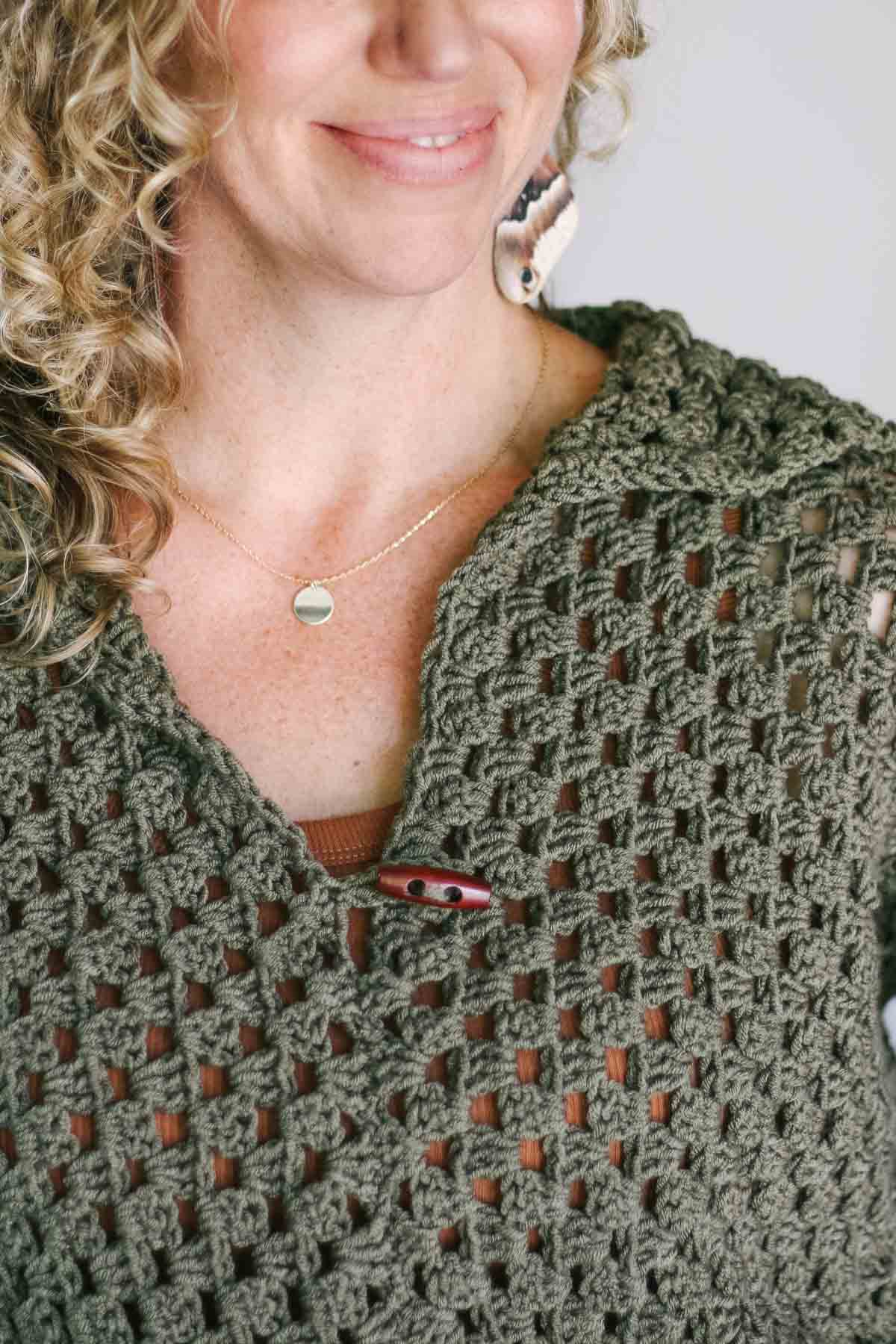
Add Button and Button Loop: Try the sweater on to check the neckline fit. Decide where you’d like the button closure and place a marker there.
Attach yarn at this point on the right edge of the neck opening. With the smaller hook, chain 5–8 stitches (enough to fit around your button). Slip stitch back into the same spot to form a button loop. Fasten off.
Sew the button to the sweater on the left edge of the neck opening, directly across from the loop.
Weave in remaining ends: Since you’ve been weaving in your ends as you go, you shouldn’t have many left. (Right!? 😉
Blocking: Once all ends are woven in, you may do a light steam blocking using either a steamer or iron with steam setting. Focus on any areas that aren’t laying as flat as you’d like, such as the sleeve decreases or ribbing seams. Do not touch steamer or iron directly to yarn.
Slip into your new Moss Sweater, fold over that cozy collar, and show off just how magical a few granny hexagons can be!
More Free Hexie Sweater Patterns
If you enjoyed making the Moss Sweater, I think you'll love these other hexagon crochet garment patterns.
- Taylor Swift Crochet Dress Pattern | Made From Granny Stitch Hexagons
- 20 Crochet Hexagon Cardigans + Sweaters for Beginners
- Crochet Hexagon Beach Coverup Free Pattern
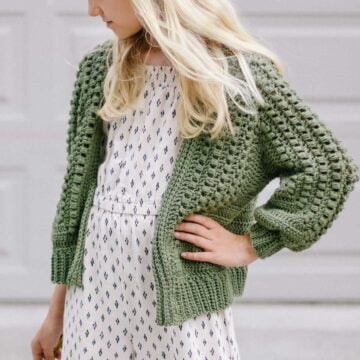
- Child's Crochet Hexagon Cardigan Pattern With Toddler Sizes
- Day Date Hexagon Cardigan Crochet Pattern
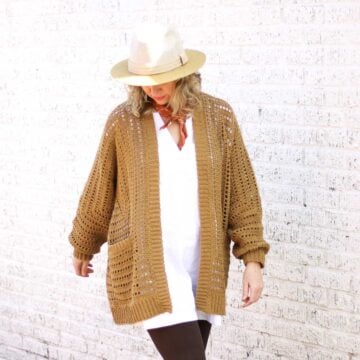
- Mini Mezzo Crochet Cardigan - Kids Sizes 4-12


That was so fun! Now what?
Invitation to our Private Community
Come discuss crocheting {variation of keyword} and lots of other projects and techniques in our Make & Do Crew community. Here thousands of helpful crocheters answer each other's questions and share their stitches. Join us!


Leave a Reply